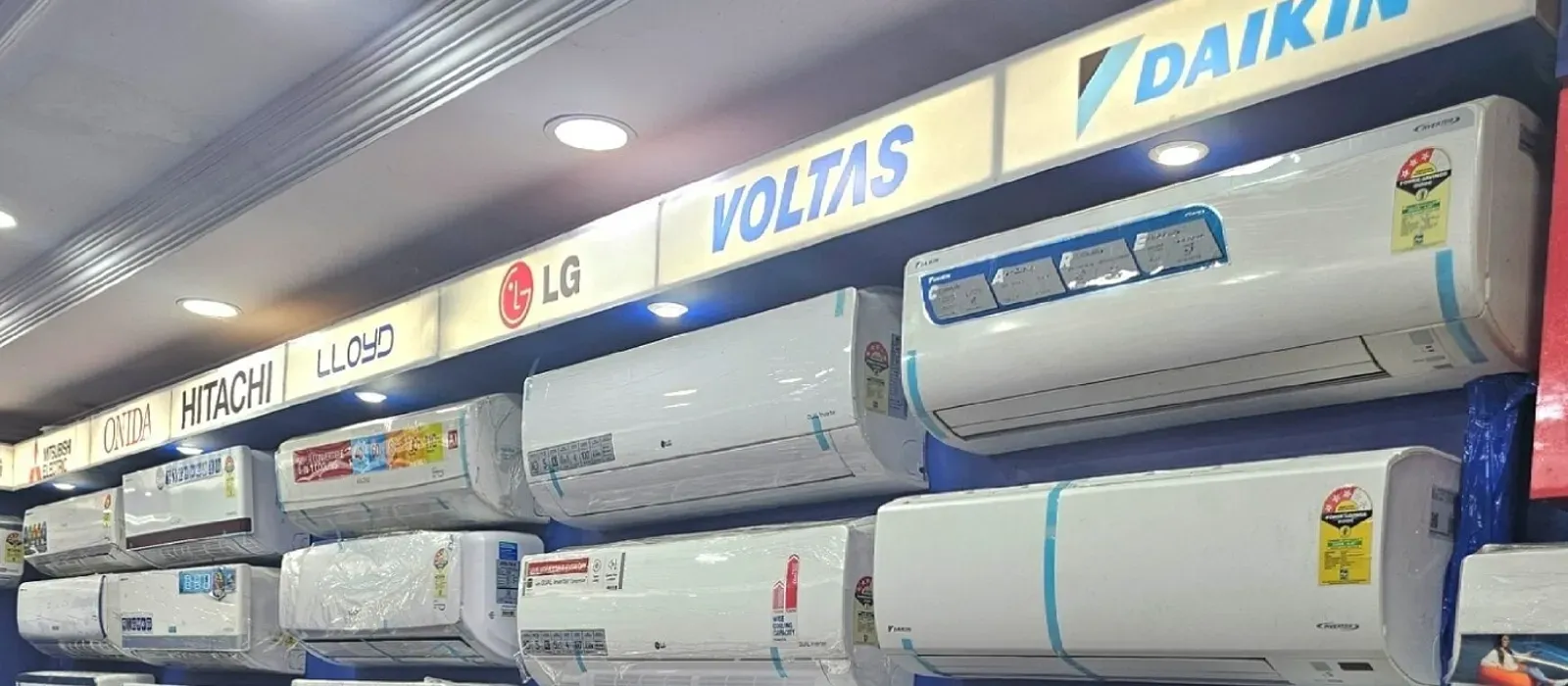
Most AC purchases in Kerala now start on a phone screen. The buyer reads reviews, shortlists two or three models, finds the best price across a marketplace and a large electronics chain, and walks into the conversation already knowing the model number and the number they want to pay.
That is a good thing. An informed buyer is easier to work with than an uninformed one.
The problem starts one step later, when that researched price gets compared against a quote from a dealer who is pricing something different. The screen price is for a carton. The dealer quote is for a working air conditioner on your wall, in your building, on your electrical supply. Those are not the same product, and the gap between them is where most Kerala AC complaints are born.
Two businesses that look identical from outside
A large-volume dealer and an engineering-led dealer both sell you the same 1.5 ton inverter split. The economics behind the two sales have almost nothing in common.
The volume model runs on velocity. Margin per unit is thin, often thinner than customers expect, so profit depends on how many boxes move per week and how fast stock turns over. Everything in the process is built around that: the price is set to win the comparison, installation is subcontracted to a partner team paid per job, and the accessories are treated as a separate transaction if they come up at all. Attachment revenue, extended warranty, finance commission and accessory upsell are where the margin is recovered. The customer profile that model is built for is a price-first residential buyer who wants a specific model at a specific number, which is exactly what online research produces.
None of that is dishonest. It is a legitimate business, it is efficient, and for a straightforward installation it often works out fine.
The engineering model runs on the installed system. The unit is one line in a quote that also covers how it is mounted, how it is powered, how it drains, and who answers the phone in year three. The margin comes from doing the whole job properly rather than from moving the maximum number of cartons before the season ends.
The mistake buyers make is not choosing the volume dealer. It is comparing a volume price against an engineered quote and concluding that one of them is overcharging.
What the box price actually assumes
Almost every advertised AC price in India assumes a standard installation. Standard usually means:
- indoor and outdoor unit within about three metres of each other
- an outdoor unit that can sit on a supplied wall bracket, at a height reachable without special access
- an existing power point of adequate rating within reach
- a drain that can run to an existing outlet with natural fall
- no core cutting through a difficult wall, no scaffolding, no special mounting
Take any one of those away and the job needs material and labour that were never in the price. In Kerala, at least two of them are usually missing.
The line items that turn a box into a working system
Voltage stabiliser
Kerala's supply problem is rarely scheduled load shedding. It is feeder faults, maintenance shutdowns, and the restoration spike that follows them. Inverter ACs tolerate a wider voltage band than older fixed-speed machines, which is why showrooms increasingly say a stabiliser is unnecessary, but that claim needs to be tested against the model's actual stated range and the site's actual voltage history. A stabiliser costs a fraction of an inverter PCB. We work through the decision properly in our stabiliser guide for inverter and non-inverter ACs.
Outdoor unit support: bracket, floor stand, or catwalk stand
The bracket in the carton, where one is included at all, is sized for a light unit on a sound wall. Real sites need more than that:
- Wall brackets rated for the actual unit weight, in a coastal-grade finish if the site is anywhere near the sea
- Floor stands where the outdoor unit sits on a terrace, a sit-out slab, or the ground, keeping it above monsoon splash and standing water
- Catwalk or service stands where the outdoor unit is on an upper floor or an awkward elevation and a technician needs somewhere safe to stand during service
The last one is the item buyers almost never think about at purchase and always think about at the first service call. If the only way to reach the outdoor unit is a ladder against a wet wall, every future service visit becomes slower, riskier and more expensive, and some technicians will simply decline the work.
Outdoor unit protection
Units at ground level, in car porches, along compound walls, or on any public-facing elevation need a cage or guard. Copper theft is real, physical damage is more common than theft, and an unguarded ground-level condenser in a rented or commercial property is a standing liability.
Copper, insulation and the pipe run
Extra length beyond the standard run is billed by the metre, and the grade matters. Thin-wall copper and cheap insulation are the two easiest places for an installer to save money invisibly. The failure shows up as a slow refrigerant loss a year later, and by then it looks like a product fault rather than a materials decision.
Drainage
Kerala runs at high ambient humidity for most of the year, which means a residential split produces a serious volume of condensate. The drain needs continuous fall, a sensible route, and an outlet that will not back up in monsoon. Drain problems are one of the most common post-installation complaints we attend, and almost all of them are routing decisions made in five minutes on installation day.
Electrical readiness
A dedicated circuit of the correct rating, cable sized for the run, a working earth, and an isolator within reach. "There is a plug point in that corner" is not electrical readiness.
An indicative comparison
The figures below are illustrative ranges for a typical Kerala residential install, not a quotation. They exist to show the shape of the arithmetic, not to fix a price.
| Line item | In the advertised box price | Typical real requirement |
|---|---|---|
| Indoor and outdoor unit | Yes | Yes |
| Standard installation labour | Usually yes | Yes |
| Copper beyond 3 m | No | Common on first-floor and rear-wall installs |
| Voltage stabiliser | No | Site-dependent, often advisable |
| Wall bracket upgrade or floor stand | Partially | Common on terrace, ground and coastal sites |
| Catwalk or service access stand | No | Needed on upper-floor and awkward elevations |
| ODU cage or guard | No | Needed on public-facing and ground-level units |
| Dedicated circuit, MCB, earthing | No | Frequently needed on older homes |
| Drain rerouting | No | Common where the natural route does not work |
| Core cutting through a difficult wall | Sometimes | Site-dependent |
A ₹5,000 saving on the carton is a genuine saving. It is also smaller than the total of three or four of the rows above, and those rows get purchased separately, at retail, from whoever is standing in front of you on installation day, usually under time pressure.
Why researched pricing pushes the market this way
When a buyer arrives with a model number and a screen price, the fastest way for any seller to win the order is to agree to that number and quietly scope the job down to fit it. Nobody lies. The stabiliser is "not needed for inverter", the standard bracket is "fine", the existing drain "will manage", and the plug point is "enough for now". Every one of those is defensible in isolation. Together they are how a correct purchase becomes a poor installation.
The counter is not to distrust the dealer. It is to insist that both quotes describe the same job before you compare them.
What to ask for in writing
Ask every seller you are comparing, including us, for the following on the quotation:
- Standard installation definition. How many metres of copper, what bracket, what drain length.
- Accessory line items, priced separately. Stabiliser make and model, stand type, cage, extra copper rate per metre.
- Electrical scope. Who is providing the circuit, the MCB, and the earth, and whether that is inside or outside the quoted number.
- Service access. How a technician will reach the outdoor unit in year two, and what that adds now.
- Who attends a fault. The dealer, a subcontracted partner team, or a manufacturer call centre, and what the response commitment is during peak season.
- What the warranty covers and who logs the claim. A manufacturer warranty is only as useful as the party willing to run the claim for you. Ask too how parts for the model are sourced once the warranty ends, because that is when they are paid for out of your pocket.
If a quote cannot answer those six questions on paper, it is not a lower price. It is an incomplete scope.
Where HRS sits, honestly
We are not the cheapest source of a carton, and we have said so plainly before. Large retailers discount popular models hard to clear stock, and on a given unit the gap between our price and theirs can run to several thousand rupees.
What we quote instead is the whole installation as one accountable package: the unit, the stabiliser matched to your locality's voltage behaviour, the stand or catwalk your outdoor unit actually needs, the cage if the unit is exposed, the copper and drain done to spec, and the electrical work checked before the machine is energised. Every line is itemised at market rate, so you can see what you are paying for and remove anything you do not want.
As an authorised sales and service partner for Daikin and Carrier and an authorised dealer for LG, Godrej, Toshiba and Midea, we can also do the part most buyers only value later: if the unit develops a covered fault while it is still in warranty, the claim is logged through the official channel by the same team that installed it, rather than handed back to you as a phone number.
For commercial buyers the arithmetic is even clearer. Itemised billing, one point of contact across multiple units, and documented service history are procurement requirements, not preferences.
When the cheap box price is the right answer
To be fair about it: if you are installing a standard 1.5 ton split in a ground-floor or first-floor room, with the outdoor unit going on a sound wall at reachable height, a stable supply, an existing dedicated circuit, and a short natural drain run, the marketplace price with retailer installation is a perfectly sensible decision, provided the brand has authorised service and parts within reach of your home. Take it, and keep the difference.
The moment the site involves a coastal location, an exposed or high-mounted outdoor unit, unstable supply, a long pipe run, multiple units, a rented or commercial property, or any equipment whose failure costs you money, the package conversation stops being an upsell and starts being the actual job.
The bottom line
Compare like with like. A carton price and an installed-system price answer different questions, and the second one is the number you actually live with for the next ten years. The same logic applies to the brand inside the carton: the cheapest unit to buy is not always the cheapest to keep running once the warranty ends and the repairs are yours to pay for.
Planning an AC purchase in Kerala? Hitech Refrigeration Services (HRS) quotes the full installed package: unit, stabiliser matched to your locality's supply behaviour, wall bracket, floor or catwalk stand, ODU cage where the site needs one, copper, drainage and electrical readiness, all itemised at market rate. Authorised sales and service partner for Daikin and Carrier, authorised dealer for LG, Godrej, Toshiba and Midea, with engineers across all 14 districts. Request a quote or contact our team and we will scope the site before quoting a number.