
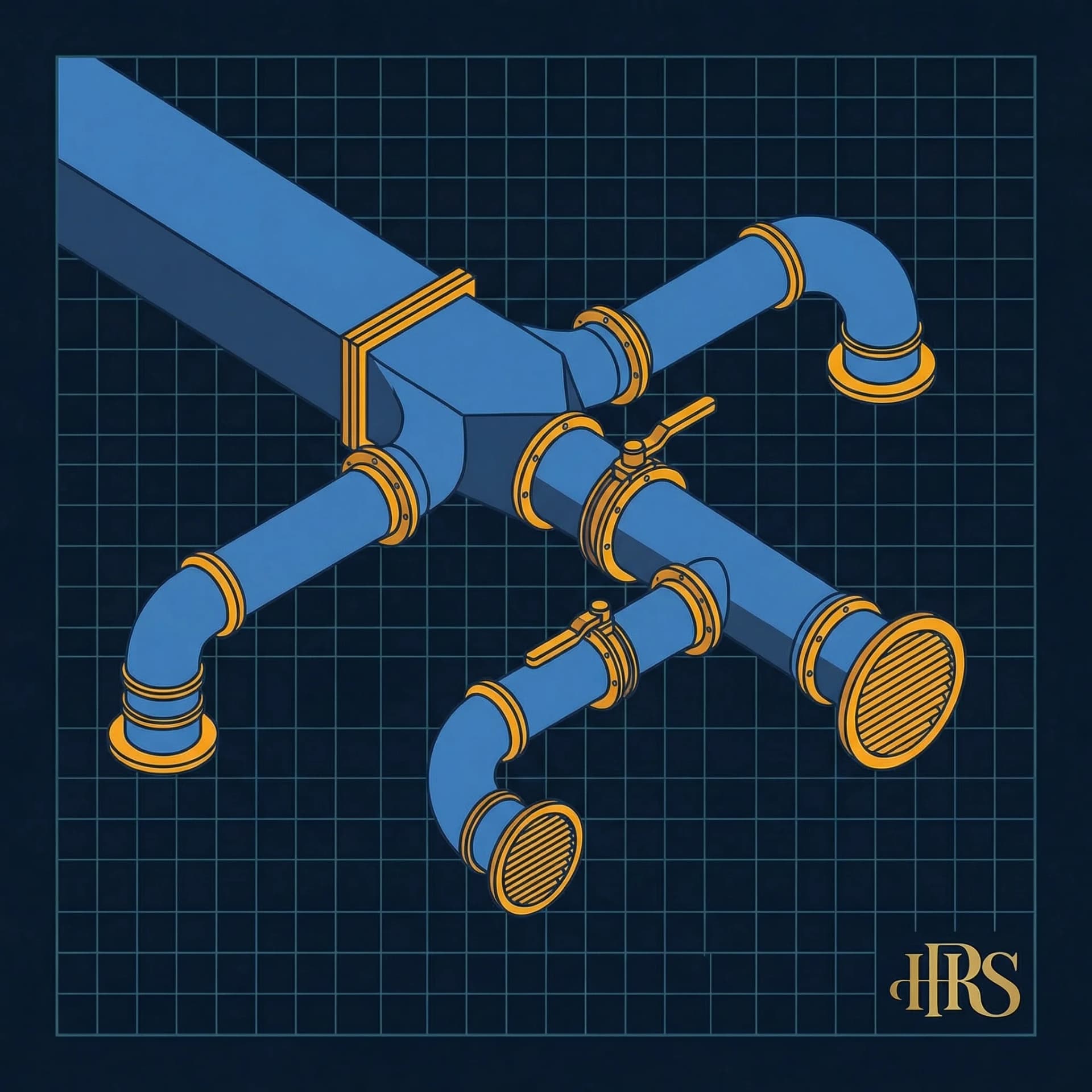
Custom Ducting, Fabrication & Ventilation Systems
Ducting and ventilation delivered as a full SITC package across Kerala: GI fabrication, fresh-air and kitchen exhaust, clean-room air distribution (ISO 14644-1 Class 5-9), insulation, and testing, adjusting and balancing.
Handled by
HRS Projects
We take the site details, arrange an inspection, and follow up with a written scope and quotation.
Mon to Sat, 9:00 to 18:00.
First time here
You have reached Hitech Refrigeration Services.
Custom Ducting, Fabrication & Ventilation Systems is one line of work we run in-house. HRS scopes, installs, and services HVAC, refrigeration, and cold-chain systems across Kerala, with the same company answering for the design, the installation, and the service call afterwards.
Operating since 1999
Service lineage from Aircon India South, incorporated as Hitech Refrigeration Services Pvt. Ltd. in 2008.
Kerala-wide, from five bases
Head office in Pachalam, Kochi, a dedicated Bus and Reefer facility in Kalamassery, and branch support in Thiruvananthapuram, Kozhikode, and Thiruvalla.
65+ on the team
Project, service, and transport refrigeration teams under one company, so scoping, execution, and after-sales stay with the same firm.
25+
Years Active
300K+
Tons Installed
36M+
Sq Ft Cooled
220K+
Man-Days
65+
Team Members
The Air Path
Good ducting turns HVAC equipment into usable comfort.
When rooms feel stale, noisy, patchy, or humid, the issue is often the air-distribution system. Duct routes, returns, dampers, diffusers, insulation, and access points need to work together.
Balanced airflow
Supply throws, return routes, and dampers are planned for the occupied room.
Condensation control
Insulation, vapour sealing, and supports prevent sweating and ceiling damage.
Noise discipline
Velocity, terminal choice, and acoustic collar detailing reduce avoidable noise.
Service access
Access panels and damper locations remain usable after interiors are complete.
Air-Movement Paths
Different spaces need different ducting and ventilation outcomes.
A bank office, kitchen, hospital, and clean room all move air differently. The scope follows the use case.
Comfort Cooling Ducts
Best for: Offices, banks, showrooms, clinics, and hospitality areas.
HRS focus: Supply, return, diffuser layout, insulation, and ductable AC throw planning.
Fresh-Air and Ventilation
Best for: Sealed or high-occupancy rooms that need healthier air exchange.
HRS focus: Fresh-air routing, treatment, exhaust coordination, and balancing.
Kitchen and Exhaust Systems
Best for: Professional kitchens, utility spaces, basements, and industrial areas.
HRS focus: Canopy, make-up air, odour, grease load, and maintainable exhaust paths.
Clean-Room Air Distribution
Best for: Pharma, hospital OT, labs, food, and electronics environments.
HRS focus: ISO Class 5-9 support, pressure zones, filtration coordination, and testing.
Quote request
Request a quote for Custom Ducting, Fabrication & Ventilation Systems.
The service is already selected. Add the site, the scope, and how to reach you, and the enquiry goes straight to the team that handles this work.
How This Work Runs on Site
How the job runs
- •We review ceiling depth, return-air route, occupancy density, noise sensitivity, and operating pattern before locking the air-distribution approach.
- •Duct sizing, grille and diffuser selection, supply throw count, acoustic collar dampening options, insulation, and access points are coordinated before execution.
- •Final testing checks airflow, pressure drop, damper settings, noise behaviour, and handover practicality.
What is in scope
- •Custom ducting, ventilation, clean-room air distribution (ISO 14644-1 Class 5-9), grille, diffuser, damper, and return-air coordination
- •Ductable AC throw-count optimisation based on occupancy density, room depth, and expected usage
- •Thermal and acoustic insulation, optional acoustic collar dampening using nitrile, and testing or air balancing where terminal noise or airflow needs extra control
What stands behind it
- •Ducting is treated as an air-distribution system, not only sheet-metal fabrication.
- •HRS plans comfort, acoustic behaviour, condensation control, and service access together so the installation remains usable after the ceiling closes.
- •Commercial, institutional, hospitality, healthcare, and premium residential projects benefit from tighter coordination between HVAC execution and interior finish.
Frequently Asked Questions
What duct materials do you use, and what works best in Kerala's humidity?
We fabricate GI ducts, pre-insulated duct systems, and flexible final connections depending on the project. In Kerala, insulation and vapour protection matter as much as the sheet metal itself because poorly detailed ducting can sweat, stain ceilings, and encourage mould growth.
Can you retrofit ducting into an existing building?
Yes, provided the ceiling space, shaft routing, and return-air path are planned properly. We retrofit ducting in working offices, hotels, banks, and healthcare spaces by phasing the work carefully to reduce disruption. On a high-efficiency retrofit the duct side often matters more than the equipment: new plant fed through undersized or leaking ducting gives back much of the efficiency it was bought for.
Do you handle fresh-air and exhaust systems, not just cooling ducts?
Yes. We design supply air, return air, treated fresh air, toilet exhaust, kitchen exhaust, staircase pressurisation, basement ventilation, and industrial exhaust systems as part of a complete air-movement package.
Can HRS support clean-room or controlled-air spaces?
Yes. Where the project scope calls for it, we support clean-room air distribution typically across ISO 14644-1 Class 5 to Class 9, covering pharma compounding, hospital operating theatres, biotech labs, food processing, and electronics assembly environments, along with pressure-zone coordination, filtration coordination, insulation detailing, and testing or balancing with the wider HVAC and project team.
How do you make sure the airflow is balanced after installation?
Every properly executed duct project should end with testing, adjusting and balancing (TAB). We verify airflow, pressure drop, diffuser throw, throw count, and damper settings so rooms do not end up overcooled, undercooled, noisy, or starved of ventilation, and the recorded readings go into the handover file rather than staying with the technician.
Related Guides and Service Areas
Connected service lines and supporting guides for your requirement.
Planning ducting or ventilation work?
Share the room use, ceiling condition, fresh-air or exhaust needs, and project stage. HRS will scope the airflow path before quoting.
Handled by
HRS Projects
We take the site details, arrange an inspection, and follow up with a written scope and quotation.