
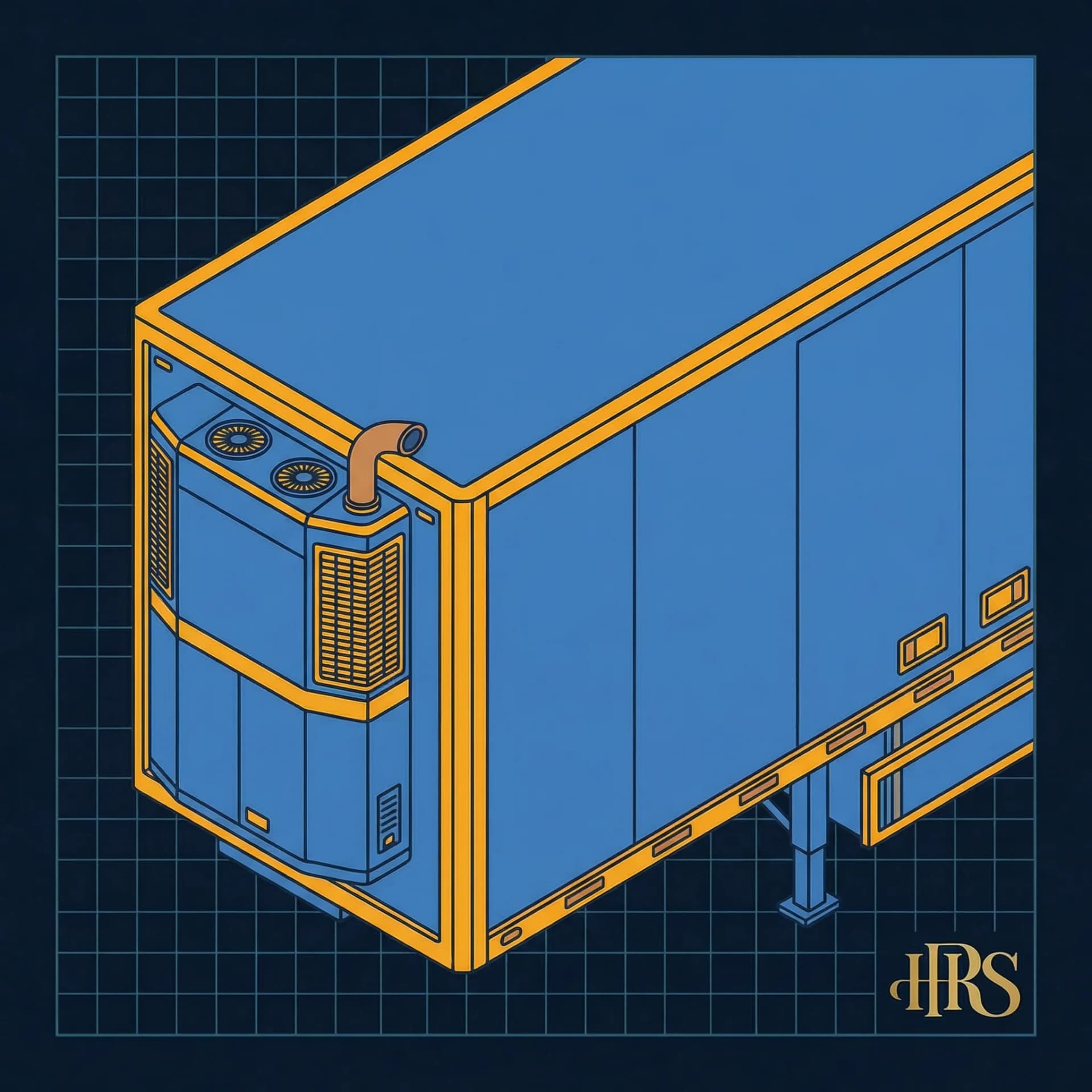
Transport Refrigeration Unit Service & Body Fabrication
Transport refrigeration unit (TRU) installation, commissioning, maintenance, and breakdown service across Kerala, plus GRP-insulated truck body fabrication. Thermo King, Carrier Transicold, Daikin Zanotti, SuperSnow, and Ice Make body builds.
Handled by
HRS Bus & Reefer
Urgent faults are logged and escalated straight to the division rather than queued behind routine work.
Mon to Sat, 9:00 to 18:00. Round-the-clock support for contracted emergency cover.
First time here
You have reached Hitech Refrigeration Services.
Transport Refrigeration Unit Service & Body Fabrication is one line of work we run in-house. HRS scopes, installs, and services HVAC, refrigeration, and cold-chain systems across Kerala, with the same company answering for the design, the installation, and the service call afterwards.
Operating since 1999
Service lineage from Aircon India South, incorporated as Hitech Refrigeration Services Pvt. Ltd. in 2008.
Kerala-wide, from five bases
Head office in Pachalam, Kochi, a dedicated Bus and Reefer facility in Kalamassery, and branch support in Thiruvananthapuram, Kozhikode, and Thiruvalla.
65+ on the team
Project, service, and transport refrigeration teams under one company, so scoping, execution, and after-sales stay with the same firm.
25+
Years Active
300K+
Tons Installed
36M+
Sq Ft Cooled
220K+
Man-Days
65+
Team Members
Authorised for this work
Brands HRS is authorised to supply and service on this line.




The Cold-Chain System
Cargo temperature depends on the body and the TRU working as one.
A strong refrigeration unit cannot compensate forever for weak insulation, loose doors, or repeated air leakage. A good build reduces heat gain first, then selects and commissions the TRU around the real route.
Insulated shell
PUF GRP panels, joints, doors, and seals reduce the heat load the TRU has to fight.
Door discipline
Sliding strip curtains and easy-use doors reduce warm-air exchange during deliveries.
TRU sizing
Unit choice is matched to cargo, body length, temperature band, and route pattern.
Commissioning proof
Pull-down, defrost, controller, leakage, and airflow checks catch mismatches early.
Vehicle Build Paths
Choose the vehicle path before choosing hardware.
Refrigerated, dry, fish-duty, and TRU-only support each change the body, door, insulation, and commissioning scope.
Refrigerated Truck Bodies
Best for: Food, dairy, frozen, seafood, pharma, and temperature-sensitive distribution.
HRS focus: 80 mm, 100 mm, or 125 mm insulation matched to chilled or frozen duty.
Dry Insulated Bodies
Best for: Weather-protected movement where active refrigeration is not required.
HRS focus: Lightweight insulated body construction for cleaner protected distribution.
Fish Truck Bodies
Best for: Seafood and wet-duty movement with ice, water, and wash-down needs.
HRS focus: 100 mm PUF, drainage planning, seals, and easy-clean duty details.
Reefer Body Access Add-Ons
Best for: Operators who want safer daily access to high truck bodies during loading, inspection, and wash-down.
HRS focus: Collapsible or fixed foot steps, door hardware, drainage details, and body-side protection matched to route use.
TRU Installation and Service
Best for: New units, mixed fleets, and breakdown support.
HRS focus: Installation, commissioning, refrigerant work, controller faults, and planned service.
Quote request
Request a quote for Transport Refrigeration Unit Service & Body Fabrication.
The service is already selected. Add the site, the scope, and how to reach you, and the enquiry goes straight to the team that handles this work.
How This Work Runs on Site
How the job runs
- •We review cargo type, route length, door-opening pattern, chassis, and required temperature range before body or TRU selection.
- •The insulated body and refrigeration unit are planned together so insulation thickness, low-leakage detailing, strip curtains, and door hardware match the operating duty.
- •Commissioning checks pull-down, air leakage risk, door closure, airflow, controller behaviour, and service records before handover.
What is in scope
- •GRP PUF refrigerated, dry, and fish truck bodies with route-suited insulation and door planning
- •Sliding strip curtains, easy-opening and easy-closing doors, drainage, thermal-break detailing, and low air leakage where relevant
- •Collapsible or fixed foot steps for reefer trucks where safer body access is needed during loading, inspection, or cleaning
- •TRU installation, commissioning, AMC, breakdown diagnosis, and fleet support for Carrier Transicold, Thermo King, Daikin Zanotti, SuperSnow, and related systems
What stands behind it
- •Truck-body performance is treated as part of cold-chain uptime, not a cosmetic fabrication decision.
- •Reduced air exchange, high insulation, and clear temperature-range planning help reduce compressor run time and cargo-temperature drift.
- •HRS can manage the body, TRU, service, and breakdown path under one Bus and Reefer division.
Frequently Asked Questions
Which TRU brands does HRS install and service?
HRS installs and services transport refrigeration units from Thermo King, Carrier Transicold, Daikin Zanotti, and SuperSnow. This covers the full range of units used in refrigerated truck and trailer operations across Kerala.
What is the difference between TRU installation and commissioning?
Installation is the physical mounting of the refrigeration unit on the vehicle, including subframe preparation, refrigerant charging to the manufacturer's specified weight, electrical connections, and drain routing. Commissioning is the structured pre-delivery check that confirms the unit is pulling to setpoint, holding temperature correctly, and operating within the manufacturer's parameters before the vehicle enters service.
Does HRS offer AMC options for transport refrigeration?
No. Due to the high variability in vehicle usage, route conditions, and operational patterns, we do not offer fixed-rate Annual Maintenance Contracts (AMC) for transport refrigeration units. Instead, we provide structured periodic maintenance and scheduled servicing on a per-visit or planned-interval basis to keep fleets operational.
What happens if a TRU breaks down during a route?
HRS provides breakdown support covering the refrigeration unit itself: fault diagnosis, refrigerant recovery and recharge, compressor, condenser, and evaporator work, controller and sensor troubleshooting, and defrost system faults. For pharmaceutical, seafood, and dairy routes where load loss is not recoverable, fast diagnosis matters as much as the repair.
What truck body classes does HRS offer?
HRS sells three PUF-insulated GRP truck body classes: refrigerated truck bodies with 80 mm, 100 mm, or 125 mm insulation for active chilled or frozen transport; dry truck bodies with 30 mm PUF for protected distribution without active refrigeration; and fish truck bodies with 100 mm PUF and a drainage-pipe variant for wet seafood and ice-carrying duty.
Can HRS handle the insulated body and the TRU as one job?
Yes. HRS coordinates the GRP-insulated body fabrication, subframe work, and TRU installation as a single cold-chain build. For ongoing operations we can also service both the body and the refrigeration unit under the same relationship, rather than splitting the scope across multiple vendors.
What affects lead time on a truck-body build?
Lead time depends on chassis type, body size, insulation thickness, duty class (refrigerated, dry, or fish), and whether a TRU installation, multi-compartment layout, or subframe fabrication is part of the scope.
Which vehicles can HRS build an Ice Make reefer body on?
HRS builds on factory-new, refrigeration-rated chassis sized to the body length. Pickups and mini trucks (Tata Yodha and Intra, Ashok Leyland Dost and Bada Dost, Mahindra Bolero Pik-Up, Isuzu D-Max) take direct-drive bodies up to about 10 ft. Medium and heavy chassis (Tata 407, Ultra and LPT, Eicher Pro, Ashok Leyland Partner, Ecomet and Boss, BharatBenz) take diesel-drive bodies from roughly 12 ft up to 22 ft and beyond. See the Vehicle and Chassis Compatibility tables on this page for the full platform-by-length breakdown.
Can HRS add fixed or collapsible foot steps to reefer trucks?
Yes. For reefer bodies where operators need safer daily access, we can include collapsible or fixed foot steps as part of the body scope, along with door hardware, drainage, and other access details matched to loading, inspection, and wash-down use.
Related Guides and Service Areas
Connected service lines and supporting guides for your requirement.
Building or servicing a refrigerated vehicle?
Share the cargo type, route pattern, chassis, body length, and temperature band. HRS will scope the TRU and body path together.
Handled by
HRS Bus & ReeferUrgent faults escalated
Urgent faults are logged and escalated straight to the division rather than queued behind routine work.