Ask a showroom what an AC costs to run and you will usually hear "very less, it is 5 star". Ask what that means in rupees and the conversation tends to stop.
It does not need to. Every AC sold in India carries a Bureau of Energy Efficiency (BEE) label with its annual electricity consumption, measured under one standard method. Kerala's domestic tariff is a published schedule. Put the two together and you get a number that can actually be compared across models: rupees per hour of cooling.
This guide works that number out for the inverter split ACs registered with BEE today, and shows what changes it.
The standard measure: rupees per hour of cooling
The kWh figure on a BEE star label is not a guess. It is calculated from the unit's ISEER (Indian Seasonal Energy Efficiency Ratio) over 1,600 hours of operation a year, spread across Indian outdoor temperatures from 24°C to 43°C, weighted by how often each temperature occurs, with the room held at the standard 27°C rating condition. That makes it the same yardstick for every brand and model.
Divide the label figure by 1,600 and you have the unit's average power draw over a typical Indian cooling hour. Multiply by your tariff and you have the cost of that hour:
For a 1.5 ton unit with a label figure of 898 kWh a year, on a ₹7.60 tariff:
You can do this for any model in a showroom with the label and a phone calculator.
Which tariff to use in Kerala
KSEB's domestic (LT-I) tariff, as set by the Kerala State Electricity Regulatory Commission for 1 April 2025 to 31 March 2027, works in two halves:
| Monthly consumption | How it is billed | Energy charge |
|---|---|---|
| Up to 250 units | Telescopic: each slab at its own rate | ₹3.35 (first 50) rising to ₹8.50 (201-250) |
| 251-300 units | Non-telescopic: every unit at one rate | ₹6.75 |
| 301-350 units | Non-telescopic | ₹7.60 |
| 351-400 units | Non-telescopic | ₹7.95 |
| 401-500 units | Non-telescopic | ₹8.25 |
| Above 500 units | Non-telescopic | ₹9.20 |
These are energy charges only. The fixed charge also steps up with each slab, and electricity duty and any fuel surcharge are added on top.
A household running even one AC through the Kerala summer usually ends up above 250 units, so the figures below use the non-telescopic rates. ₹7.60 (a 301-350 unit month) is the middle case.
What an hour costs, by tonnage and star rating
We pulled every inverter split AC registered on the BEE star label database in October 2026 and kept the 7,376 listings carrying a current label (valid to 31 December 2027, so rated on the tighter 2026 star bands). The table uses the median listing in each group. A listing is a registered model number, so colour and variant versions of one machine can appear more than once; the medians are robust to that, but the counts are listings, not distinct designs.
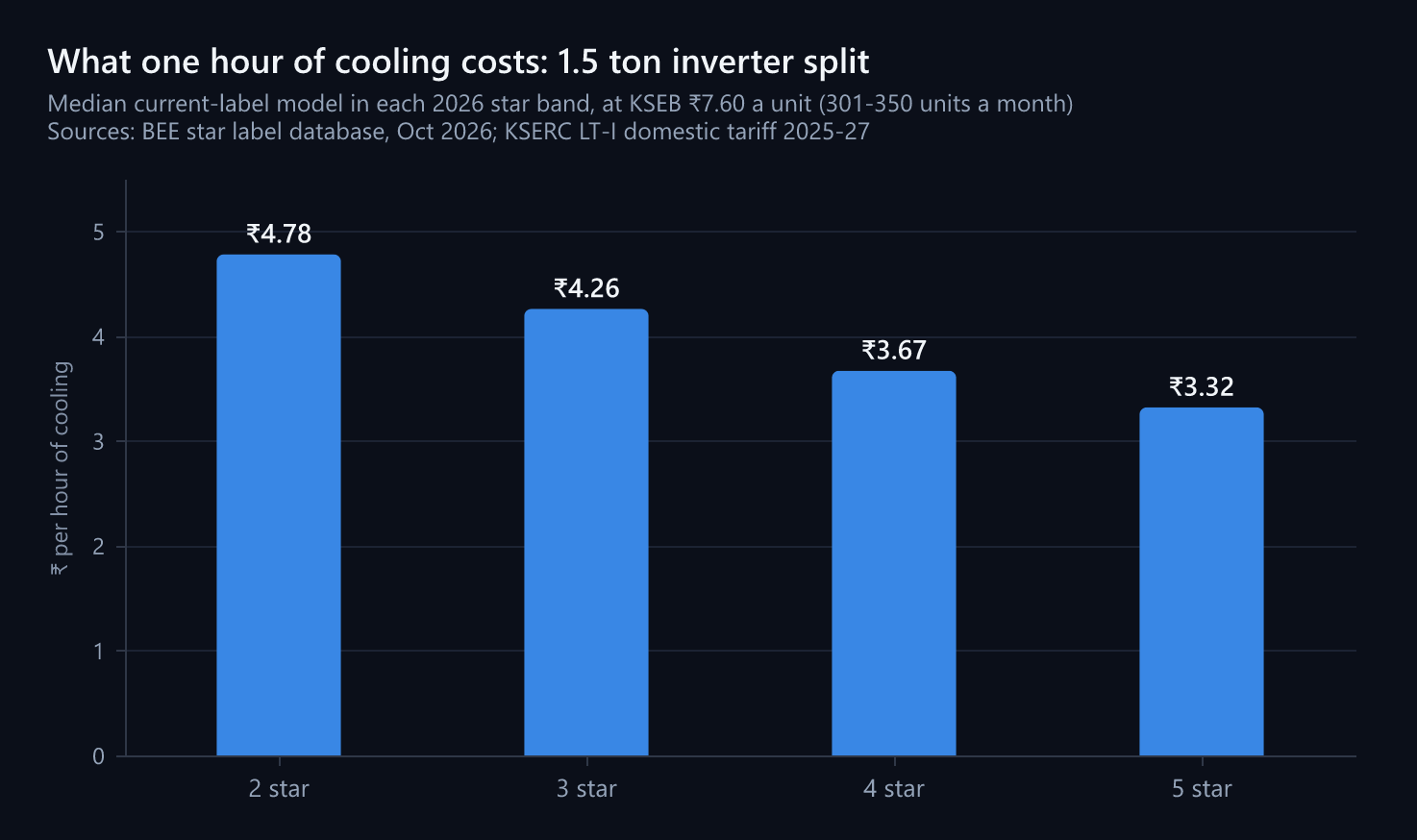
1.5 ton inverter split, the most common home AC:
| Star rating (2026 bands) | Listings | Median ISEER | Label kWh/year | Average draw | ₹/hour at ₹6.75 | ₹/hour at ₹7.60 | ₹/hour at ₹8.25 |
|---|---|---|---|---|---|---|---|
| 2 star | 659 | 3.91 | 1,007 | 0.63 kW | ₹4.25 | ₹4.78 | ₹5.19 |
| 3 star | 1,089 | 4.38 | 898 | 0.56 kW | ₹3.79 | ₹4.26 | ₹4.63 |
| 4 star | 601 | 5.13 | 774 | 0.48 kW | ₹3.26 | ₹3.67 | ₹3.99 |
| 5 star | 642 | 5.70 | 700 | 0.44 kW | ₹2.95 | ₹3.32 | ₹3.61 |
1 ton and 2 ton, at ₹7.60:
| Star rating | 1 ton: label kWh/year | 1 ton: ₹/hour | 2 ton: label kWh/year | 2 ton: ₹/hour |
|---|---|---|---|---|
| 2 star | 692 | ₹3.29 | 1,398 | ₹6.64 |
| 3 star | 606 | ₹2.88 | 1,252 | ₹5.95 |
| 4 star | 523 | ₹2.48 | 1,071 | ₹5.09 |
| 5 star | 470 | ₹2.23 | too few listings | - |
Read across a row and the pattern is plain. A 1.5 ton 5 star unit costs about ₹1 an hour less to run than a 3 star at the same tariff. Over 1,600 hours that is roughly ₹1,500 a year, and more if the unit runs longer, as most Kerala bedroom units do.
The brand matters far less than the star band
The more surprising result is how little the brand changes the running cost once the star band is fixed.
Within each 1.5 ton band, the spread is narrow. Among 3 star listings, 80% fall between 875 and 940 kWh a year. Among 5 star listings, 80% fall between 671 and 727 kWh a year. Every one of the thirteen major brands we checked, including all six we sell, registers 1.5 ton models in at least two star bands. In other words, almost every brand sells both a cheaper-to-run and a dearer-to-run 1.5 ton AC.
So the question "which brand is most efficient?" has a less useful answer than "which star band is this particular model in?". The model's label tells you the running cost. The brand tells you something else: who will service the unit, how quickly parts can be found, and what it costs to keep running once the warranty ends. We cover that side in the most common AC buying mistakes in Kerala.
How your setpoint changes the number
The BEE figure assumes the room is held at 27°C. Most Kerala homes run cooler than that, and the Ministry of Power's own guidance, issued when it proposed 24°C as the default setting, is that each degree lower costs roughly 6% more electricity. Applying that rule to the 1.5 ton medians at ₹7.60:
| Setpoint | 3 star, ₹/hour | 5 star, ₹/hour |
|---|---|---|
| 27°C (label basis) | ₹4.27 | ₹3.32 |
| 26°C | ₹4.52 | ₹3.52 |
| 25°C | ₹4.78 | ₹3.72 |
| 24°C | ₹5.03 | ₹3.92 |
| 22°C | ₹5.55 | ₹4.32 |
The 6% rule is an approximation, not a law of physics, but the direction is reliable. A 5 star unit run at 22°C costs about the same per hour as a 3 star unit run at 27°C. How you run the AC is worth as much as which one you bought.
The 250-unit trap
The non-telescopic structure creates a cliff that is specific to Kerala and easy to miss. Once a month's consumption crosses a slab boundary, the higher rate applies to every unit on the bill, not just the extra ones.
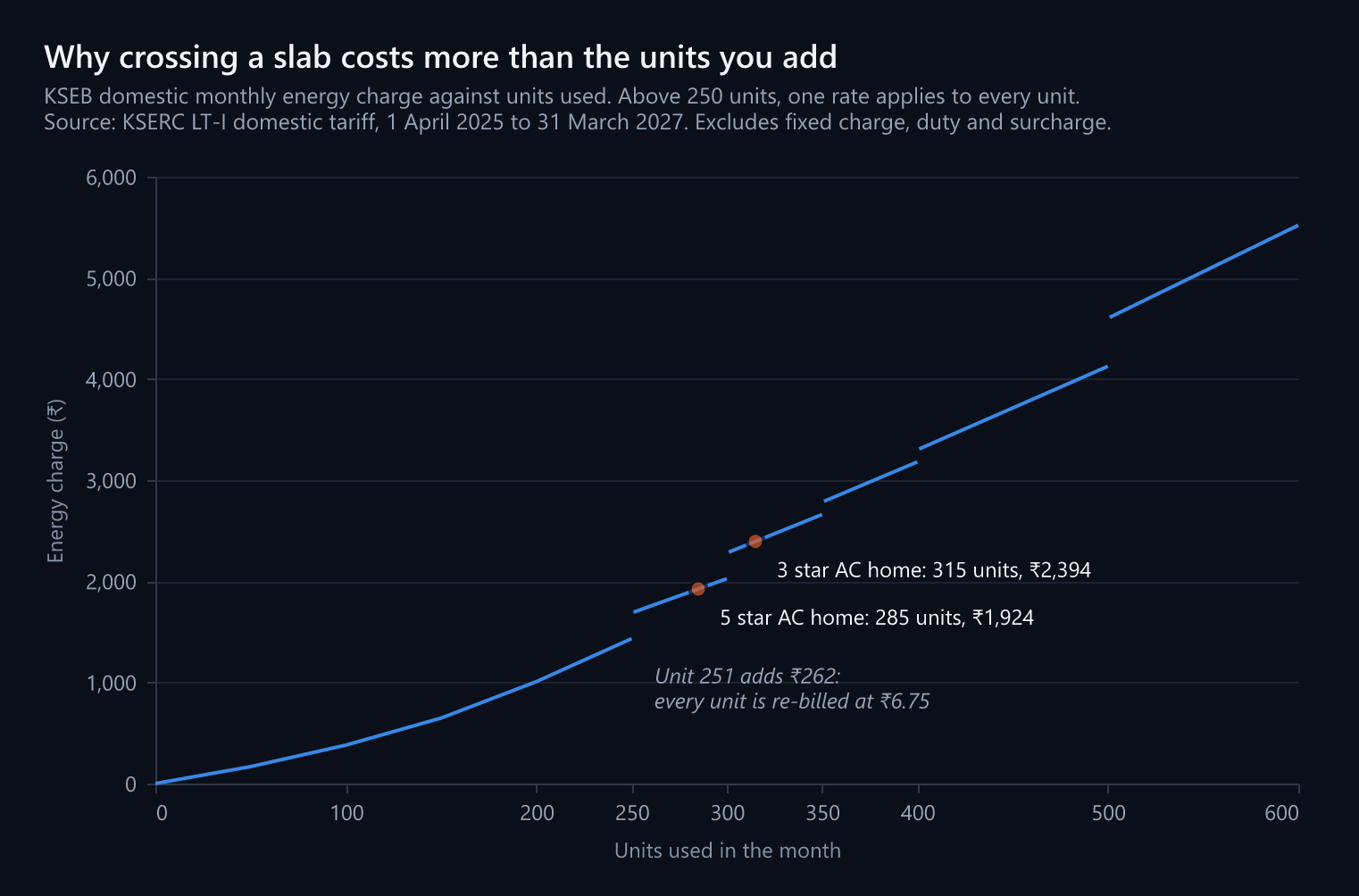
Take a household that uses 180 units a month without the AC, and adds a 1.5 ton unit running 8 hours a night for 30 nights:
| 3 star unit | 5 star unit | |
|---|---|---|
| AC consumption (8 h × 30 nights) | 135 units | 105 units |
| Total for the month | 315 units | 285 units |
| Slab | 301-350, ₹7.60 on all units | 251-300, ₹6.75 on all units |
| Energy charge | about ₹2,390 | about ₹1,920 |
The AC itself used only 30 units more, roughly ₹230 worth at ₹7.60. The bill is about ₹470 higher, because those 30 units pushed the whole month into the next slab. Over a six-month summer, that is close to ₹2,800 from one slab boundary.
This is also why the same AC can look cheap to run in one home and expensive in another. The question is not only how much the AC uses, but which side of a slab boundary it leaves the household on.
What the label does not tell you
The label figure is a standard, not a promise. Your real cost per hour depends on:
- Hours and season. 1,600 hours is the rating basis. A bedroom unit in Kerala used most nights of the year will run longer than that.
- Room heat load. A west-facing room under a concrete roof needs more cooling per hour than the standard assumes. Sizing it correctly matters more than the star rating: see choosing the right AC tonnage.
- Installation. A long, poorly insulated pipe run or a boxed-in outdoor unit can cost more efficiency than the gap between two star bands. We explain this in AC installation shortcuts in Kerala.
- Maintenance. A choked filter or a dirty outdoor coil raises the power draw for the same cooling. Regular cleaning keeps the unit close to its label.
- Commercial tariffs. Shops, offices and clinics are billed under different KSEB schedules, with different rates. The method above still works; only the tariff changes.
Using this in a showroom
- Read the kWh/year figure off the label and check the label's validity period. A current label runs to 2027.
- Divide by 1,600 and multiply by your tariff to get rupees per hour.
- Multiply by your realistic hours a year, not 1,600, to get your annual cost.
- Compare the yearly difference between two models against the price difference between them.
- Check whether the AC's extra units would push your household across a slab boundary.
If the dearer model pays back its premium within a few years at your hours of use, it is the cheaper AC to own. If you use the room for an hour a few evenings a month, it may never pay back, and the lower star band is the sensible buy.
Want the running cost of a specific model worked out for your room? Hitech Refrigeration Services (HRS) sizes the unit from your room's heat load, compares models on label consumption and your actual tariff slab, and quotes the complete installation itemised at market rate. Authorised sales and service partner for Daikin and Carrier, authorised dealer for LG, Godrej, Toshiba and Midea, with engineers across all 14 districts. Request a quote or contact our team.