Industry estimates put inverter models at over three-quarters of new AC sales in India, and most showrooms now treat "inverter" as the default. Fixed-speed units, often sold as "non-inverter", are still on shelves and still cheaper. The question buyers ask is whether the extra money buys anything real.
It does, but not equally for everyone. The difference comes down to how many hours the AC runs, how humid the room is, and what happens when something fails in year six.
What actually differs
Both types use the same refrigeration cycle: a compressor, two coils, an expansion device and refrigerant. The difference is in how the compressor is driven.
A fixed-speed AC has one speed: full. When the room is warmer than the setpoint, the compressor starts and runs at full capacity. When the room reaches the setpoint, it stops. The thermostat holds the temperature by switching the compressor on and off, often several times an hour.
An inverter AC converts the mains supply to DC and then back to a variable-frequency supply for the compressor motor. That lets the compressor run anywhere from well below its rated capacity to somewhat above it. Once the room is cool, it slows down and keeps running gently instead of stopping.
The word "inverter" refers to that drive electronics, not to the refrigeration side. That distinction matters later, when we get to repairs.
Why the inverter saves energy, and when it does not
An AC is sized for the hottest hours of the year. Most of the hours it actually runs are not the hottest. On a Kerala night, or a monsoon afternoon, the room needs a fraction of the unit's rated capacity.
A fixed-speed unit meets that partial need by running at full capacity in short bursts. Every start draws a surge of current and takes a few minutes to reach stable operation, and every stop lets the coil warm up again. An inverter meets the same need by running slower. At low speed its coils are generously sized for the refrigerant flowing through them, so the compressor works across a smaller pressure difference and each unit of electricity moves more heat.
BEE's ISEER rating is built to capture exactly this. It weighs the unit's efficiency across Indian outdoor temperatures from 24°C to 43°C by the hours each occurs:
Fixed-speed and inverter units are rated on the same label format, so the annual kWh figure on each label compares directly. The rule that follows is simple: ignore the word "inverter" on the box and compare the kWh on the two labels. We work out what those kWh figures cost per hour on KSEB tariffs in our AC running cost guide.
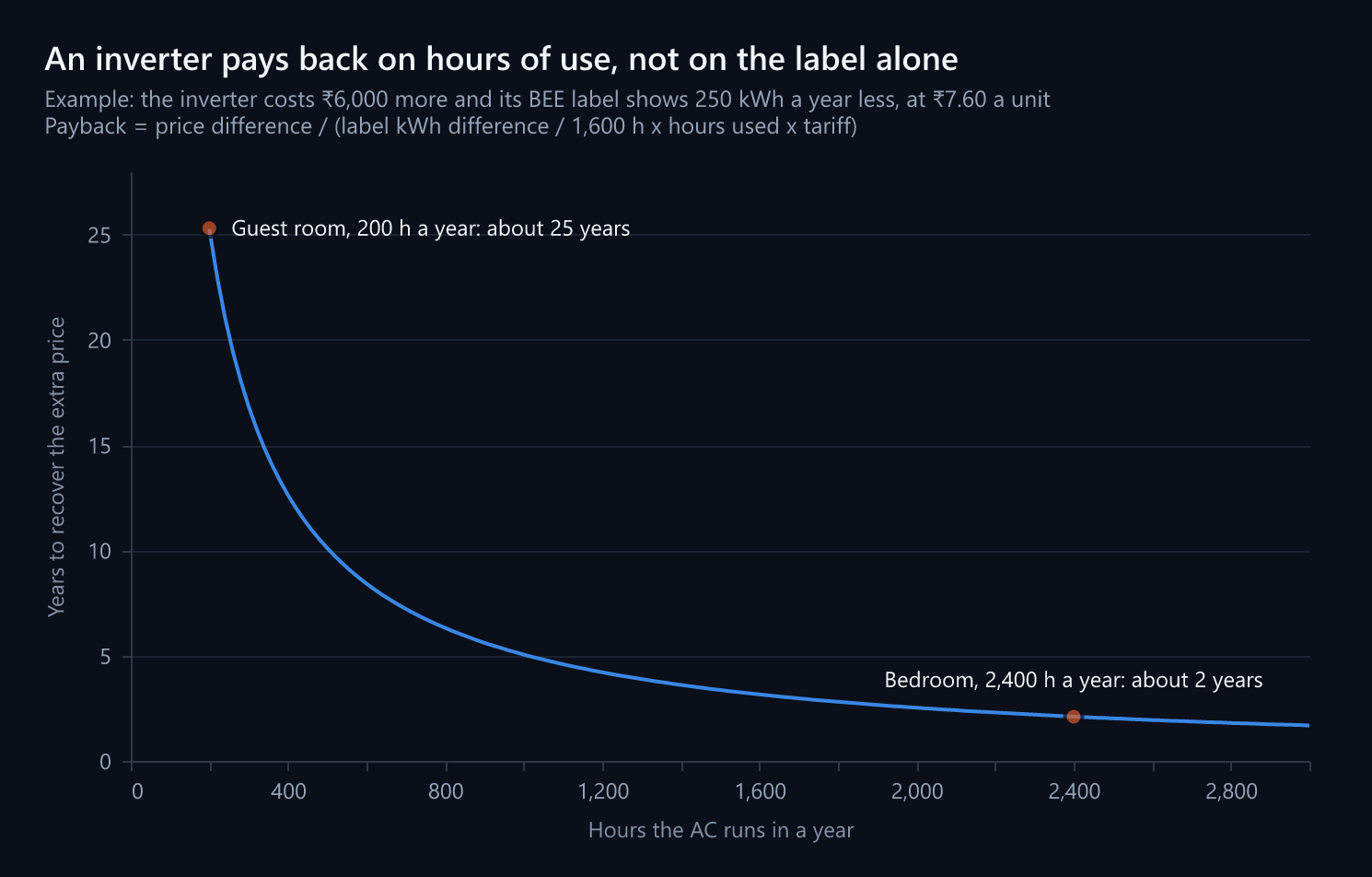
The catch is that the saving accrues per hour of use. Whether the inverter's extra price pays back depends on how long the AC runs:
Suppose the two labels differ by 250 kWh a year and the prices by ₹6,000, on a ₹7.60 tariff. For a bedroom used 8 hours a night for 300 nights, 2,400 hours a year:
For a guest room used 200 hours a year, the same sum gives about 25 years, longer than the unit will last. Same two ACs, opposite answers.
What each does to humidity in a Kerala room
In Kerala, the stickiness of a room often bothers people more than its temperature. An AC removes moisture when air passes over a coil colder than the air's dew point, and the two types handle that differently.
Fixed-speed units run the coil very cold while the compressor is on, which removes moisture well during that time. The weakness is the off-cycle. On many units the indoor fan keeps running when the compressor stops, and water still clinging to the coil evaporates back into the room. An oversized fixed-speed unit makes this worse: it reaches the setpoint quickly, stops often, and leaves the room cool but clammy.
Inverter units run continuously, so there is no off-cycle re-evaporation. But a slow compressor with a fast indoor fan produces a warmer coil, which removes less moisture. Good inverter controls deal with this by slowing the indoor fan as the compressor slows, keeping the coil cold. Done well, this gives inverters a real advantage in humid climates: an early study of a variable-speed unit in a hot and humid region found it could lower the share of its capacity spent on temperature, as opposed to moisture, from 0.80 to 0.60, while saving around 20% of annual energy.
Practically, for a Kerala room:
- Do not oversize either type. Oversizing is the most common cause of a cold, damp room. Our tonnage guide covers this.
- On an inverter, use the dry or dehumidify mode during the monsoon, when the room is humid but not hot.
- On a fixed-speed unit, avoid settings that keep the indoor fan running continuously after the compressor stops.
Why temperature and humidity need to be read together is explained in dry bulb temperature and relative humidity.
Reliability and repair cost
This is where the fixed-speed unit still has a genuine argument.
An inverter AC carries considerably more electronics: the drive board in the outdoor unit, more sensors, and communication between the indoor and outdoor boards. Those boards are the parts most exposed to Kerala's voltage swings and post-outage surges, and a replacement board typically costs ₹4,000 to ₹15,000 depending on brand and model, as listed in our AC parts guide. An inverter fault also usually needs a technician who can read the fault codes and test the drive, not just the refrigerant side.
A fixed-speed unit is simpler. Its common electrical failures, a start capacitor or a contactor, are cheap parts that most competent technicians can replace. Its weakness is mechanical: every start puts a high inrush current through the compressor, several times an hour, and on a weak rural supply that start can pull the voltage down far enough to trip or strain the unit.
Two further points tilt the balance:
- Voltage protection matters for both, for different reasons. Our stabiliser guide covers which type needs what.
- Fixed-speed parts may get harder to find. As brands shift their ranges to inverters, fixed-speed models are discontinued, and the parts supply follows. A fixed-speed unit bought today should come from a brand with authorised service and parts in your district, or its cheap repairs may not stay cheap.
When a fixed-speed AC still makes sense
- Low hours of use. A guest room, a room used a few evenings a month, or a standby unit. The inverter's saving never accumulates enough to pay back its price.
- A tight budget with good local service. If the choice is between a well-supported fixed-speed unit and a poorly supported inverter, the supported unit is usually the better buy.
- Sites where electronics have a short life, such as locations with frequent lightning surges and no protection planned. Even here, adding protection to an inverter is often the better answer than avoiding the inverter.
For a bedroom used most nights, a home office, a shop or a clinic, the inverter is almost always the cheaper AC to own, provided it is the right size and installed properly.
The bottom line
Inverter versus fixed-speed is not really a question about technology. It is a question about hours. Compare the kWh on the two labels, multiply by the hours you will actually use the room, and set the yearly difference against the price difference. Then check who will repair whichever unit you choose, because the inverter's saving disappears quickly if a board takes three weeks to arrive.
Choosing between an inverter and a fixed-speed AC for a specific room? Hitech Refrigeration Services (HRS) sizes the unit from the room's actual heat load, compares models on label consumption at your hours of use and tariff slab, and plans voltage protection for your locality's supply. Authorised sales and service partner for Daikin and Carrier, authorised dealer for LG, Godrej, Toshiba and Midea, with engineers across all 14 districts. Request a quote or contact our team.