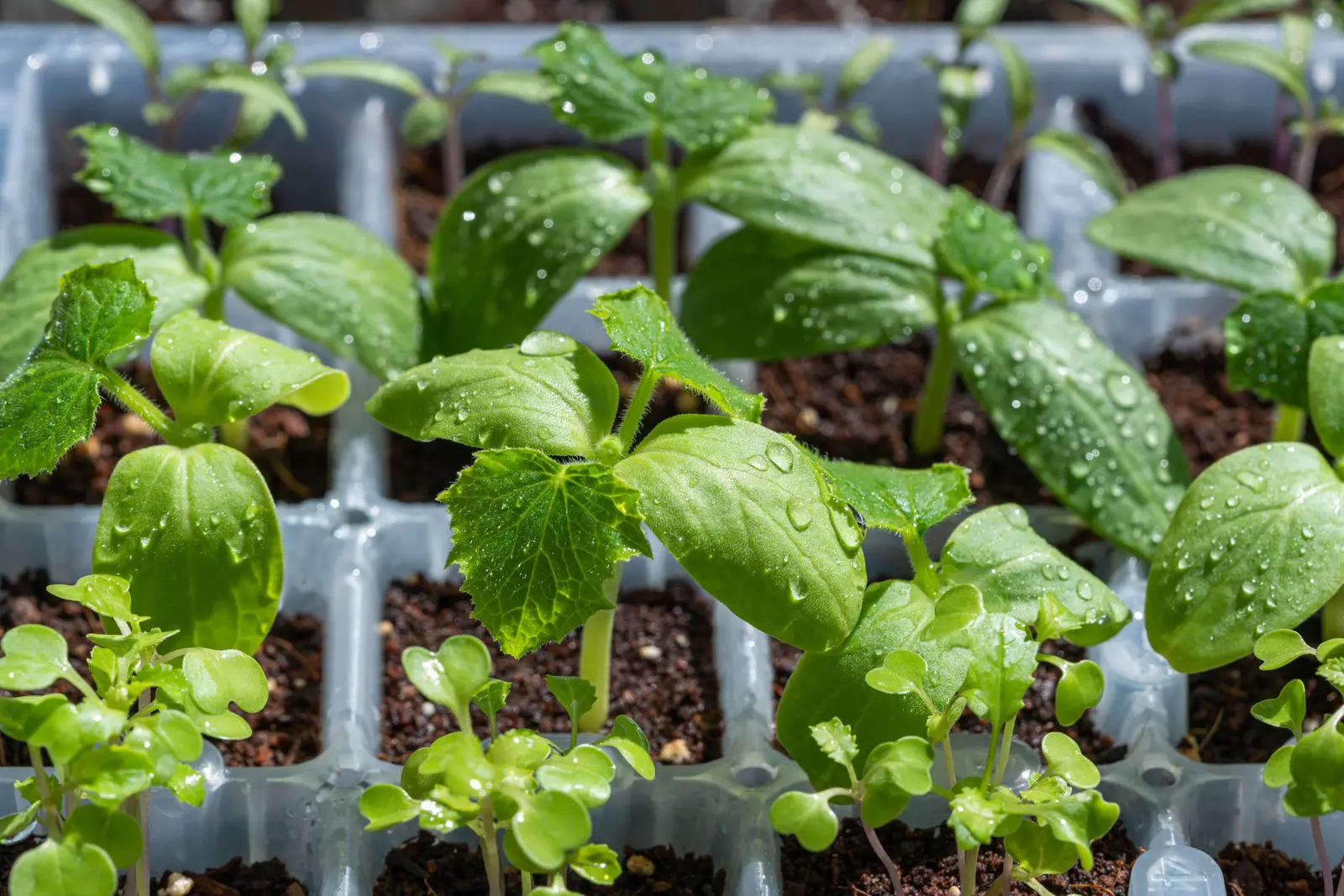
An indoor farm is not an air-conditioned room with plants in it. It is a climate machine wrapped around living things that fight back. Every litre of water you feed the crop comes back at you as vapour, the lights pour in heat, and the plants only grow well inside a narrow band of temperature and humidity that they themselves are constantly trying to push you out of.
That is why the climate system, not the lighting or the nutrients, is usually what decides whether an indoor farm in Kerala works or quietly turns into a mould problem. Kerala makes it harder than almost anywhere, because the outside air is already carrying 70 to 90 percent relative humidity for much of the year, so the latent load is the headline, not the temperature. This guide is about building the climate system correctly, from the plant outward.
Start with the plant, not the building blueprint
Most HVAC sizing starts from the building: wall area, roof gain, occupancy, glazing. For an indoor farm that is the smaller half of the problem. The bigger half walks in with the crop.
In a sealed growing room, almost all of the water you irrigate leaves again as vapour. The commonly used figure is around 90 to 95 percent of applied water transpiring straight into the room air through the leaves. A farm is, in climate terms, a machine for turning irrigation water into airborne moisture, and the dehumidification system has to remove every litre of it, every day, or the room drowns.
So the sizing has to be calculated backwards from plant biology, not just the building envelope:
- daily fertigation volume, which sets the moisture the room must remove
- peak plant transpiration, which sets the worst-case latent load
- lighting heat load, which for dense LED arrays is substantial
- plant count and canopy density
- the target temperature and relative humidity band for the crop and its stage
A working rule for an indoor-farm dehumidification load reads more like "room volume plus plant count plus light load plus irrigation volume against a target RH" than anything on a building drawing. Get that arithmetic wrong and you do not get a slightly warm room. You get mould, root rot, crop loss and a power bill for equipment that was never going to cope. The climate equipment has to carry both sensible tonnage (heat) and latent tonnage (moisture), matched to the biology, not borrowed from an office cooling table.
VPD is the real setpoint
Growers do not actually care about temperature and humidity in isolation. They care about vapour pressure deficit, or VPD, which is the gap between how much moisture the air is holding and how much it could hold at that temperature. VPD is what drives transpiration, nutrient uptake and growth, and it is the number a good climate system is really holding steady. The psychrometric relationship behind it is the same one we set out for Kerala conditions in dry bulb temperature and relative humidity in Kerala HVAC.
Here is the trap. A PLC touchscreen can request a temperature and a humidity, and the controls can be flawless, but the request is only a wish. The hardware still has to physically fight live plant transpiration to deliver it. Automation works only when the machinery underneath it can actually move the heat and moisture a dense canopy throws off. Controls do not remove water. Compressors and coils do.
Climate changes with the growth stage
A single fixed setpoint across a crop cycle is a beginner's mistake. The plant's needs, and the loads it puts on the room, change completely from tray to harvest.
- Propagation and young plantlets. Tender young leaves are fragile. Harsh, direct air from an ordinary blower causes rapid transpirational stress and leaf scorch, the horticultural equivalent of wind burn. Early growth needs soft, uniform air movement and a stable micro-climate so roots develop evenly. Weak roots and stunted plants are set up here, long before any flowering, and poor climate at this stage can kill young plantlets outright.
- Vegetative growth. The canopy fills out and the transpiration load climbs. The priority is uniform air distribution and a stable VPD across the whole room, so no corner runs hot, humid or stagnant.
- Flowering and fruiting. This is the peak. A dense room of plants transpires together, and at the flowering peak thousands of litres of irrigation water can be released into the air as vapour over a cycle. A fruiting crop like premium strawberries is at its most demanding here. The hard part is the transition curve: holding a precise VPD while the moisture load climbs steeply. If the dehumidification cannot keep pace, humidity spikes and the crop is at risk within hours.
- Maturation, harvest and drying. For a crop like saffron, the stigmas are dried under controlled low humidity after harvest, which is a climate task in its own right. A drying room is not an afterthought, it is another setpoint the same system has to hold.
Saffron is a clean example of the whole arc: the corm develops vegetatively, the plant flowers (the flower is the harvest), and the stigmas are then dried. Each phase asks the climate system for something different. Most leafy greens, culinary herbs and microgreens never flower for harvest at all, they are cut in the vegetative stage, so for those crops the peak load is about canopy density rather than a flowering transition.
Why ordinary and home ACs fail in a sealed room
A standard comfort air conditioner, and certainly a home split, is built to cool a leaky room full of people, not a sealed room full of transpiring plants. Drop one into a grow room and several things go wrong at once.
- It has no fan static pressure to push conditioned air across deep canopy rows, so the air never reaches the far side of the room.
- It dumps cold air straight onto the top leaves while the lower canopy sits in stagnant, saturated air.
- Under a massive, continuous latent load it runs cold and wet, ices up, and short-cycles, because it was never designed to pull that much water out of the air.
- It has no way to remove moisture without over-cooling, so the room temperature collapses before the humidity is under control.
The result is the worst of both worlds: a cold room that is still soaking wet. Without proper latent capacity, a sealed grow room becomes a mould swamp, and the equipment that caused it is running flat out the whole time. This is the same reason comfort AC is the wrong tool for any precision environment, which we cover in precision cooling versus comfort cooling.
The dehumidification engine
Removing moisture without crashing the temperature is the central engineering problem of an indoor farm, and it is solved in the refrigeration circuit, not the thermostat.
A serious agricultural climate system uses modulating hot-gas reheat coils and rapid compressor staging. The cooling coil pulls the air below its dew point to wring the water out, and the reheat coil puts the sensible heat back so the room does not freeze while that happens. Without reheat and staging, the room temperature collapses long before the moisture is removed, and the controls spend the day fighting themselves. This is industrial-grade latent load management, closer in spirit to cold room sizing for Kerala and industrial refrigeration than to a wall-mounted unit.
Modular commercial climate systems exist precisely to deliver the exact latent heat removal a dense canopy needs, and to hold VPD steady year after year. Home units are the wrong tool: they freeze up under the moisture load and turn the room into exactly the mould problem the farm is trying to avoid.
Moving air softly: high-static handlers, ducting and air socks
Once the air is conditioned, it has to reach every plant evenly and gently. That is an air-distribution problem, and it is where a lot of otherwise good builds fail.
The answer is high-static-pressure air handlers pushing conditioned air through custom duct transitions and, very often, high-static fabric air socks. A fabric sock delivers soft, continuous air movement along its whole length, which stabilises VPD without whipping the plants around or blasting icy air onto the top of the canopy. The air penetrates the full depth of the room evenly instead of chilling the first row and starving the last. The same terminal-selection discipline we describe in our grilles, diffusers and air terminals guide and multi-zone ducting design applies here, with the added constraint that the air has to be gentle as well as uniform.
Vertical farming: the under-canopy problem
Stacking plants on multiple tiers of racks can triple a facility's growing area in the same footprint. It also creates tight horizontal spaces where cold, humid air gets trapped under every shelf.
Standard overhead diffusers simply cannot reach the middle and lower tiers, and those plants are transpiring at full speed too. The result is relative humidity spikes between the racks and condensation settling right under the light fixtures, exactly where you least want free water. Vertical farming therefore needs forced under-canopy air distribution, delivered to each rack level, paired with dedicated industrial dehumidifiers that pull moisture from every level rather than only from the ceiling.
One warning on a popular shortcut. When humidity spikes between tiers, some growers strip the lower foliage off the plants to cut the moisture those leaves release. Resist it as a climate fix. Removing leaves to manage air is treating a mechanical problem with a horticultural knife. The better answer is air movement: small circulation fans at floor and rack level keep the saturated air moving so it cannot settle into stagnant pockets. Note the limit, though, a fan moves air, it does not lower the dew point. Circulation stops condensation forming in dead spots, but the water still has to be removed by the dehumidifier. Fans and dehumidification are partners, not alternatives.
Ductwork is where good designs quietly fail
The duct system looks like the dull part of the job. It is where many indoor farms lose their climate.
- Insulation gaps cause condensation. Even a small break in duct insulation in a humid room creates a cold spot where moisture condenses and drips, often straight onto the plants below. In an indoor farm that is not a nuisance, it is crop damage. The construction detail that prevents it is the same discipline we set out in duct sheet gauge, noise and joint fatigue.
- Sharp elbows and bad transitions choke airflow. Poor fittings build up static pressure, so air volume collapses at the far end of the room. You end up with stagnant microclimates in the corners even though the compressors are running round the clock.
- Rigid metal ducts cannot be cleaned. Microbial and biofilm buildup inside a twenty-metre rigid metal run is close to impossible to clear after a few harvests. That is why much of the industry is moving to washable fabric duct systems, which can be taken down, laundered and refitted between crops.
- Dry-fit at the factory. Factory dry-fitting the ductwork before it reaches site is the best way to guarantee clean transitions and a leak-free assembly.
- Trap the condensate properly. The dehumidifier needs a correctly designed condensate trap so it drains smoothly instead of backing up.
Custom duct fabrication and clean transitions are core HVAC project work, not an accessory, and getting them right before the first crop is far cheaper than chasing a stagnant corner after it.
Treat the climate as one integrated mechanical system
The through-line of all of this is that a controls screen, the hardware, the ducting and the dehumidification are not separate purchases. They are one mechanical system that has to be designed together and sized from the plant.
Practically, that means designing the airflow before anything is planted. Plan the full cycle in advance, from empty racks, to seedlings, to full flowering, to a drying room if the crop needs one, and make sure the equipment can physically handle the thermal and moisture load at the worst point in that cycle, not the average. A climate system that is comfortable with empty racks and drowns at flowering peak was never designed, it was guessed.
The crops that justify a proper indoor grow room in Kerala
A grow room earns its cost on one kind of crop: the exotic or temperate crop that Kerala's open climate cannot grow well, which is exactly why it stays scarce and fetches a premium. Heat and humidity keep these off most local farms, so whoever can hold the right climate indoors controls a short supply. That is the business case, and it stands only if the climate system actually holds.
The crops that make the strongest case for a sealed, dehumidified grow room in Kerala are:
- Premium indoor strawberries. A temperate, climate-sensitive crop that fruits poorly in Kerala's open humidity but performs indoors under precise temperature and VPD control. Local supply is thin and the price reflects it.
- High-value exotic culinary herbs. Basil, thyme, oregano, rosemary and other temperate herbs for hotels, restaurants and premium retail, where year-round consistency and clean, residue-free leaf command a premium that humid open-field growing cannot match.
- Exotic and temperate mushrooms. Button, shiitake and lion's mane need cool, tightly humidity-controlled rooms that Kerala's open climate never provides, unlike the common oyster mushroom that grows in ambient conditions. That gap is exactly why the specialty varieties stay rare and well priced.
- Hydroponic leafy salad greens. Lettuce, rocket and other temperate greens that bolt and turn bitter in Kerala's heat, but hold quality indoors on vertical racks under uniform airflow and tight humidity.
- Commercial microgreens. Dense, fast cycles that transpire hard for their size and spoil quickly if humidity is not held down, so dehumidification and steady air movement are the whole business, not an optional extra.
- Saffron. A temperate, high-value crop grown indoors from corms under tightly held temperature and humidity, with a controlled drying step for the stigmas.
What every one of them shares in Kerala is the latent-load problem: in a drier state the temperature is the challenge, but here the ambient humidity means moisture removal is the hard part, and it is the part cheap equipment gets most wrong. That is how a scarce, high-value crop becomes a roomful of mould.
The bottom line
An indoor farm is a precision climate system that happens to grow plants. Size it backwards from fertigation and transpiration, hold VPD rather than chase temperature, move the air softly and evenly to every tier, and remove moisture with reheat and staging that will not crash the room. Design the whole thing as one mechanical system before the first tray goes in.
That is precision-cooling engineering applied to living things, and it is the discipline HRS brings to controlled environments: sensible-and-latent load design, high-static air distribution, custom duct fabrication, and the dehumidification and controls coordination a dense canopy actually demands. The same engineering sits behind our precision cooling and custom ducting and ventilation work.
If you are planning an indoor grow room in Kerala, for exotic culinary herbs, hydroponic salad greens, premium strawberries, microgreens or any high-value crop, design the climate system before you build the grow space. Request a climate design review or contact the HRS team with your crop, your rack layout and your irrigation plan, and we will work the loads from the plant outward.