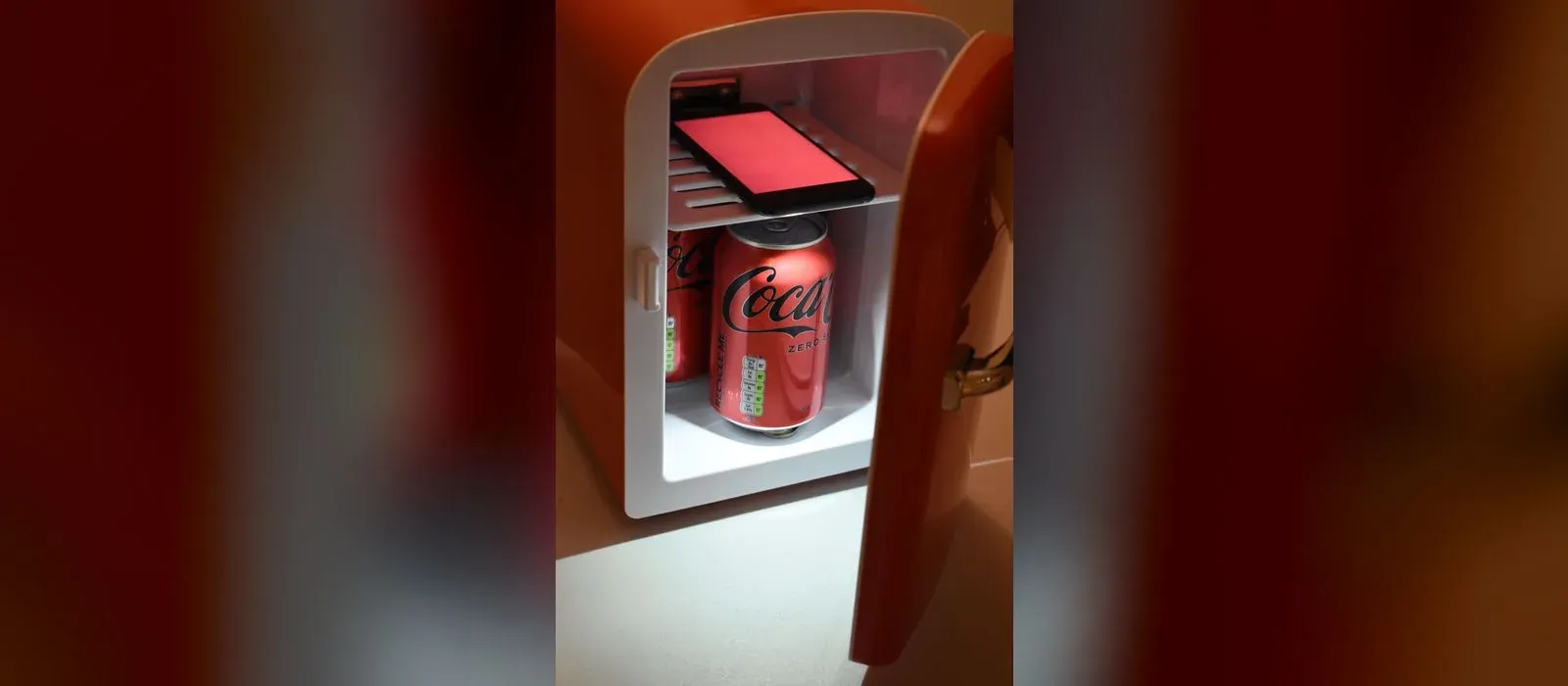
Ask a hotel operator what the in-room fridge is for and the answer is usually vague: it came with the room, it holds the minibar stock, guests expect one. Ask a housekeeping supervisor the same question and the answer is much sharper. It is the appliance that hums at night, ices up by Thursday, leaks water into the cabinet, and generates a complaint roughly once a week across a hundred rooms.
Those two answers explain why the specification for hotel in-room refrigeration has been drifting for a few years now, and why the drift is worth understanding before the next room refurbishment.
What guests actually use the in-room fridge for
Strip out the minibar stock and the real usage pattern is narrow and consistent:
- chilling drinking water and beverages
- keeping a takeaway or a half-eaten meal cold overnight
- storing medicines that must not sit at room temperature
- baby milk, formula, and expressed feeds
- fruit, and whatever came back from a day trip
Notice what is not on that list. Guests do not freeze anything. They occasionally want ice, which is not the same thing as wanting a freezer.
That distinction is the whole argument.
The three technologies, and what each one is really good at
Compressor
A miniature version of a domestic refrigerator. It holds low temperatures reliably, it can carry a small freezer compartment, and it will make ice in a tray given enough hours.
It also cycles. A compressor starting at 2am, half a metre from the bed, in a room whose whole design brief is sleep quality, is a self-inflicted wound. It vibrates, which makes bottles rattle inside the cabinet. Its freezer compartment frosts, which means manual defrost, which means housekeeping labour, which means water where you do not want it. Multiply all of that by your room count.
Absorption
The traditional silent minibar, using a heat source and an ammonia cycle. Genuinely quiet, but thermally inefficient, fussy about being perfectly level, and slow to recover once the cabinet warms up. Still in service across a lot of older properties, and still a reasonable answer where it is already installed and working.
Thermoelectric
Solid state, using the Peltier effect. No compressor, no refrigerant circuit, no vibration, and no noise beyond a small fan you have to be listening for. Nothing inside frosts, so nothing needs defrosting. There is very little to fail mechanically, which shows up as a lower service call rate across a large fleet of rooms.
The catch, and it is a real one, is that a thermoelectric unit cools relative to the room rather than to a fixed setpoint.
The number that decides everything: delta-T
A thermoelectric cabinet pulls the interior a certain number of degrees below ambient. In practical Kerala hotel conditions, with the room AC holding around 23°C to 25°C, that lands the cabinet somewhere in the region of 8°C to 14°C depending on the unit, the door discipline, and how full it is.
For chilled water, soft drinks, beer, fruit and an overnight leftover, that is completely adequate.
For anything that has to sit inside a defined band, it is not. And this is where operators get themselves into trouble, because two of the items on that usage list above are exactly that.
Medicines. A large share of temperature-sensitive medication, insulin included, is specified for 2°C to 8°C. A standard thermoelectric minibar in a warm room will not hold that, and it has no thermometer the guest can trust. If your property tells guests that medicines can be stored in the room, you have made a claim your hardware may not support.
Infant feeds. Same problem in a smaller package, with a less forgiving audience.
Neither of these is an argument against thermoelectric minibars. They are an argument for handling those two needs deliberately instead of assuming the in-room unit covers them. The workable answers are a small number of designated rooms with compressor units, or a properly monitored refrigerator at the front desk or in the housekeeping pantry, offered as a service and logged. That is a better guest experience than a silent cabinet quietly running at 11°C with somebody's insulin in it.
Why the freezer compartment is the wrong place to solve ice
The instinct is to specify a minibar with a freezer box so that guests can make ice. In practice, an in-room ice tray delivers the worst ice in the building:
- it takes hours, so it is never ready when the guest wants it
- it picks up odours from everything else in a small shared cabinet
- it frosts the compartment, which is a housekeeping cost on every single room
- it is invisible to your food-safety process, because ice is a food and nobody is monitoring that tray
Meanwhile the compartment forces a compressor into the room, which brings back the noise and the vibration you were trying to avoid.
Ice as a service, not a fixture
The properties getting this right have moved ice out of the room and turned it into something the guest asks for and the hotel delivers well.
That looks like a central or per-floor ice machine producing clean, consistent cubes, an ice bucket delivered to the room on request or set up as part of a turndown or arrival ritual, and, in properties that want to make more of it, clear or specialty ice as part of the in-room bar offering.
The operational case for that is strong:
- Better product. Machine ice is clearer, colder, odour-free, and available immediately.
- Actual food-safety control. One machine on a documented cleaning and sanitisation schedule, with a filter change record, instead of a hundred unmonitored trays.
- Lower capital and running cost per room. You stop paying for a freezer compartment, and its defrost labour, in every room in the building.
- A service touchpoint. Ice delivered is a moment of contact. Ice made in a tray is not, and cannot be charged for or remembered.
- Quieter rooms. The whole point.
For food and beverage operations, the ice machine is not a new line item anyway. Most properties already need one for the bar and restaurant. The question is whether it is sized and located to also serve rooms, which is a design decision worth making at the refurbishment stage rather than after.
Ice machine capacity, condenser location, drainage, and water treatment all need planning, and undersized machines are one of the more common back-of-house complaints we get called about. The same discipline applies as in any other commercial cooling load: size it for the peak, not for the average.
Kerala-specific considerations
Ambient control is not optional. Because thermoelectric performance is tied to room temperature, a room whose AC is switched off by the key-card system for eight hours will have a warm minibar when the guest returns, and recovery is slow. If you are specifying thermoelectric, put the minibar circuit on the always-on supply rather than the guest-switched one, and make sure the room AC is sized and maintained to actually hold its setpoint. A minibar problem is very often an HVAC problem wearing a disguise.
Humidity and condensation. At Kerala's ambient humidity, glass-fronted cabinets sweat, and door seals in permanently humid corridors degrade faster than the catalogue life suggests. Solid doors are the safer specification in coastal properties, and seal inspection belongs on the preventive maintenance list rather than the breakdown list.
Coastal corrosion. Whatever sits in the room is the least of it. The ice machine condenser, the ducted or cassette units serving the corridors, and any outdoor equipment need the same anti-corrosion treatment as the rest of a coastal HVAC installation.
Power quality. Thermoelectric modules and their drivers are electronics. In areas with a history of restoration spikes, the same voltage protection logic that applies to inverter ACs applies here too.
A specification checklist for the next refurbishment
- Decide the room's job. Chilling drinks and food, or holding a defined temperature band. Only the second one needs a compressor.
- Handle medicines explicitly. Designated rooms with compressor units, or a monitored fridge in a staff area, with a logged handover. Do not let the answer be silence.
- Take ice out of the room and put it on a machine with a cleaning schedule, a filter record, and enough capacity for rooms plus F&B at peak.
- Wire minibars on always-on power so key-card switching does not defeat the cooling.
- Specify solid doors and inspect seals in humid and coastal properties.
- Check the noise claim in the room, not the brochure. Stand where the pillow will be.
- Plan service access for whatever you install, including the ice machine condenser.
- Put the fleet on a maintenance contract rather than treating each cabinet as a separate breakdown, because at a hundred rooms the failure rate is a statistic, not an event.
Where this fits in the wider property
In-room refrigeration is a small line in a hotel's cooling budget and a large line in its complaint log. It is worth getting right for that reason alone, but the decision does not sit on its own. It connects to how the guest room AC is sized and controlled, how the kitchen and bar are cooled, how the cold room is loaded, and how all of it is maintained through a Kerala monsoon. We have written separately about restaurant and commercial kitchen cooling and cold room sizing for peak summer conditions, both of which come up in the same refurbishment conversation.
The bottom line
Put a silent cabinet in the room that does the job guests actually need, be honest about what it cannot hold, and move ice to a machine that makes it properly and a service that delivers it. That combination is quieter, cheaper to run, easier to keep clean, and considerably easier to defend in a food-safety audit than a freezer compartment in every room.
Planning a hotel refurbishment or a back-of-house cooling upgrade in Kerala? Hitech Refrigeration Services (HRS) works across hospitality properties on guest-room HVAC, kitchen and bar cooling, ice machine and cold room planning, and AMC cover for equipment fleets that cannot be serviced one breakdown at a time. ISO 9001:2015 and ISO 45001:2018 certified processes, with engineers across all 14 districts. Request a quote or contact our team to plan the specification before the rooms are stripped.