11 July 2026 · Updated 18 September 202613 min read
When Does VRF Actually Pay Off? VRF and VRV Air Conditioning in Kerala, 2026
What VRF and VRV systems are, the one Kerala use case that justifies the premium, how often a home must run one, and when a simpler system is the better spend.
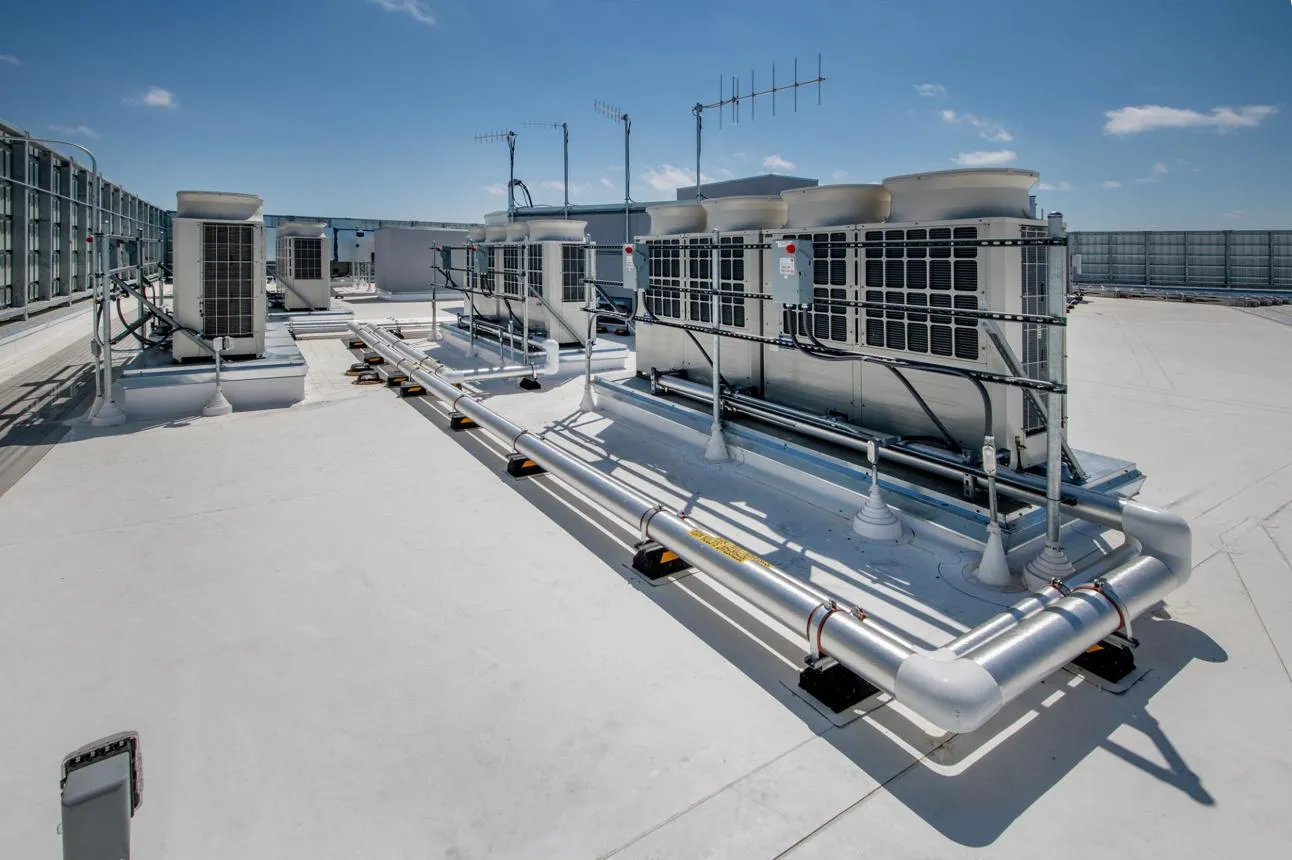
A VRF system solves a specific problem: how to cool a whole building's worth of rooms, each on its own thermostat, without lining the terrace and every wall with outdoor units. One or a few outdoor units serve dozens of indoor units through a shared refrigerant network, and an inverter compressor sends each room precisely the cooling it asks for, moment to moment. That is the promise. It is also why the technology is powerful in the right building and wasteful in the wrong one.
This guide covers what VRF and VRV actually are, where they came from, and, most importantly for anyone spending the money, the specific situations in Kerala where the premium is justified and the ones where it is not.
VRF and VRV are the same thing
The two names cause endless confusion, so it is worth settling first. VRV, Variable Refrigerant Volume, is Daikin's trademark. Daikin launched the world's first such system in 1982, and because they own the name, every other manufacturer, Mitsubishi, Carrier, Toshiba, LG, Samsung, Hitachi, sells the identical class of technology under the generic term VRF, Variable Refrigerant Flow. Same principle, different badge. When a consultant says VRV they usually mean a Daikin system specifically; VRF is the neutral term for the category.
A short history
The idea that made VRF possible was the inverter-driven compressor: a compressor whose speed, and therefore whose cooling output, can be varied continuously instead of simply switching on and off. Daikin's 1982 VRV paired that with electronic expansion valves at each indoor unit, so a single outdoor unit could feed many indoor units and give each one a different amount of cooling at the same time.
The technology then evolved in two directions that matter. First came heat-recovery systems, which can cool some rooms while heating others and move the waste heat from one to the other instead of dumping it outside. Second came steady gains in part-load efficiency, the efficiency a system delivers when it is not running flat out, which is where an air conditioner actually spends almost all of its working life. Modern VRF is, above all, a part-load machine.
How it works, briefly
A VRF system has three parts: one or more outdoor units containing the inverter compressors, a network of refrigerant piping, and many indoor units of mixed types (wall, cassette, ducted, floor-standing) on that shared network. Each indoor unit has an electronic expansion valve that meters exactly the refrigerant its zone needs. The outdoor compressor ramps its speed up and down to match the total demand of all the rooms calling at that moment.
Because most rooms rarely need full cooling at once, the system usually runs at part load, where the inverter compressor is at its most efficient. That is the core efficiency argument for VRF, and it is a real one, but only in a building whose rooms genuinely vary in load and schedule.
The one use case that justifies the premium
It is this kind of constraint, not the appeal of a premium system, that leads commercial firms like HRS to recommend VRF.
VRF costs considerably more than an equivalent count of split units, both in equipment and in the trained installation it requires. So the honest question is not "is VRF better?" but "does this building actually need what VRF uniquely provides?"
The clearest case where the answer is yes: you need many indoor units, but you do not have the outdoor space to place their condensers.
A building with thirty rooms cooled by thirty split ACs needs thirty outdoor units. That is thirty condensers to find wall or terrace space for, thirty sets of heat being rejected into the same congested area, and, on most urban commercial buildings in Kochi, Kozhikode, or Thiruvananthapuram, simply more outdoor space than exists. A VRF system serves those same thirty rooms from one or a few outdoor units in a fraction of the footprint. On a tight terrace, a façade that cannot be covered in condenser boxes, or a multi-storey fit-out where outdoor placement is genuinely constrained, that space saving is not a nicety. It is often the only workable answer.
Two further conditions strengthen the case:
- Many zones with different loads and schedules. A hotel, a hospital wing, or an office floor where rooms fill and empty independently is exactly what VRF's per-zone modulation is built for.
- Simultaneous heating and cooling. In mixed spaces where some areas need cooling while others need heating, a heat-recovery VRF moves heat between them instead of wasting it. Space heating is a small factor in Kerala, but the water version of the same idea is not. A hotel, hostel, hospital, or canteen that runs cooling and bulk hot water through the same hours can take heat off the rejection side and put it into a hot-water tank instead of buying that heat twice. It adds installed cost, so it needs a real hot-water demand profile behind it rather than an assumption, but it is the heat-recovery case that genuinely occurs here.
When there is no outdoor space at all
Some buildings fail even that test. A fully glazed elevation that cannot carry louvres, a facade under heritage or planning control, a terrace already committed to solar panels, water tanks, and fire services: on sites like these there is no acceptable location for a condenser bank of any size, and reducing the count from thirty to four does not solve it.
The answer there is water-cooled VRF. The outdoor unit rejects its heat into a cooling-tower water loop rather than into ambient air, so it has no condenser fan and needs no outdoor air path. It can be installed inside the building, floor by floor, and because it is never exposed to the weather, the coastal corrosion protection that dominates an ordinary Kerala outdoor-unit specification stops being a line item.
Two counterweights have to be stated with it. First cost is higher than the air-cooled equivalent. And the cooling tower, pumps, and water treatment become a maintenance obligation the building did not previously carry, which is a different discipline from washing a condenser coil twice a year. The efficiency argument is genuine, because loop water sits well below a Kerala afternoon's worst-case ambient and the compressor therefore works against a lower condensing temperature, but it is an argument that has to survive the added plant, not replace it.
When VRF does not make sense
The same honesty cuts the other way. For a home, a small office, a clinic, or a showroom of a few rooms, VRF is usually the wrong spend. If the building has room for a handful of outdoor units, a set of good inverter splits or a single ducted system will cool it just as comfortably, cost far less to buy, and be simpler and cheaper to service. Paying the VRF premium to cool five rooms that two ordinary systems would handle is buying a capability the building never uses.
The deciding factor is almost never prestige. It is whether the geometry of the building, the number of zones, and the outdoor-space constraint actually call for it.
For a home, ask how often it will actually run
Houses need a second test, and it gets skipped because it is a question about habit rather than about hardware: how many days a week will these rooms genuinely be cooled?
VRF is a part-load machine that earns its premium in operating hours. The capital difference over a set of splits is fixed on the day of purchase. The AMC on a shared refrigerant network is an annual cost whether the system runs or not, because the charge still has to be checked, the drain paths still have to be cleared before the monsoon, and the controls still have to be read. The efficiency advantage, meanwhile, only accumulates while the compressor is actually modulating against a real load. A household that cools rooms three or more days a week, through the year, is at least feeding that arithmetic. A house cooled on a few weekends, or an upper floor opened when relatives visit, is not: the premium has been spent, the running cost is barely reduced because there is little running, and the maintenance obligation still arrives on schedule.
Infrequent use also changes when faults are discovered. On a system used daily, a slow refrigerant loss or a sticking expansion valve shows itself early, as a room that stops holding setpoint. On a system used occasionally, nothing is watching, so the same fault surfaces on the one hot afternoon the house is full, which is the worst possible time to start a diagnosis on a brand-specific network. Rarely used systems are not spared maintenance. They need a scheduled visit precisely because nobody is monitoring them in between.
So the rule we give homeowners is simple. If the rooms will be cooled at least three days a week, most weeks, a full VRF is worth costing out properly against splits, and our VRF against split and cassette ROI guide shows how. Below that, it is a large system bought largely for the days it will not run.
The middle step: home VRF
Between a condenser under every bedroom window and a building-scale VRF sits a smaller class of equipment, sold as mini VRF or home VRF, and for an intermittently used Kerala house it is usually the sensible answer of the three. One outdoor unit in roughly the 2 to 4 ton band serves up to three indoor units, and those can be of different types, so a concealed duct unit over the living area shares a system with hi-wall units in the bedrooms.
It suits irregular use for the plain reason that the premium at risk is far smaller. There is one outdoor unit and a short refrigerant network rather than a building-length one, the indoor count is capped, and the service scope sits closer to a multi-split than to a commercial VRF. The owner still gets the two things that usually prompted the VRF question in the first place: one service ledge instead of several condenser locations, and independent control room by room.
Two cautions belong in any comparison. The three-indoor limit is a hard one, so a fourth bedroom means a second system or a different class of equipment, and that is a decision to settle at design stage rather than after the false ceiling is closed. And this class is classified as commercial product, so many units carry no BEE star rating at all, which is a classification matter and not a verdict on their efficiency. The honest comparison against the splits they replace is a modelled annual running cost at the house's real schedule. Judged that way, the energy gap narrows as indoor units are added, so the case for home VRF rests mostly on placement, elevation, and control rather than on the electricity bill. We cover the specification side under residential air conditioning.
What Kerala adds to the decision
A VRF system in Kerala faces the same pressures as any cooling equipment here, and a few of its own:
- Humidity and latent load. Kerala's moisture means indoor units and setpoints have to be chosen for dehumidification, not just temperature. An oversized or badly zoned VRF can leave rooms cool but clammy, the same failure that afflicts oversized splits.
- Coastal corrosion. In coastal districts, salt air attacks condenser coils. VRF outdoor units concentrate a lot of value in one place, so they are worth specifying with anti-corrosion coil coating and careful siting.
- Power quality. VRF is electronics-heavy: inverter drives, communication lines, and expansion-valve controllers. Kerala's voltage fluctuation and rough power-restoration events make protection and proper earthing more important, not less, than on a simple split.
- Cleanliness and dust. Dusty or high-footfall environments load filters and foul coils faster, which pushes maintenance frequency up. The system has to be specified for the environment it will actually sit in, not a clean showroom.
None of these rule VRF out. They decide how it should be specified, coated, protected, and maintained once the building genuinely needs it.
Two numbers in the proposal that are not the same thing
Every VRF quotation carries a combination ratio, and somewhere behind it a diversity assumption. The two get conflated constantly, and the confusion is expensive in only one direction.
The combination ratio, sometimes called the connection ratio, is arithmetic. It is the total nominal capacity of every connected indoor unit divided by the nominal capacity of the outdoor units, as a percentage. Connect 130 kW of indoor units to 100 kW of outdoor capacity and the combination ratio is 130%. Manufacturers publish both a hard maximum and a lower recommended figure, and those are not the same permission: the maximum is what the equipment will tolerate, the recommendation is what it will perform at. Top-discharge outdoor units usually allow more headroom than side-discharge ones, and a dedicated AHU coil is normally held at 100% with no headroom at all.
The diversity factor is a design judgement, not a nameplate figure. It says the whole building never peaks at once, because a west-facing room peaks in the late afternoon while an east-facing one peaked at breakfast, and because occupancy moves around through the day. Diversity is what makes a combination ratio above 100% defensible in the first place. It is a claim about this building, on these orientations, with this occupancy pattern.
The failure mode runs one way. Overstate diversity and the outdoor unit is undersized, and that does not show up at handover on a mild day with half the floor empty. It shows up on the first hot afternoon when every zone calls together, all of them drift above setpoint at the same time, and there is no spare capacity anywhere in the system to recover with. Nothing has broken. The machine is simply smaller than the building, and the only remedy is more outdoor capacity, which is the one item nobody budgeted for.
There is a related trap where an AHU shares a refrigerant circuit with ordinary indoor units. The AHU coil has a far larger appetite, and on a shared loop it can pull refrigerant away from the small units beside it and leave them starved while the AHU itself performs perfectly. Manufacturers cap both the combined ratio and the AHU's share of it for exactly this reason. The cleaner answer on most projects is to give the AHU its own circuit rather than to engineer around the limit.
So ask three questions of any VRF proposal: what diversity factor has been assumed, what dynamic heat-load work supports that figure, and what the combination ratio comes to at the proposed indoor-unit schedule. A bidder who cannot answer all three has selected equipment rather than sized a system.
VRF conditions the air in the room, it does not ventilate it
One assumption causes real trouble on fit-outs: that specifying VRF settles the building's air handling. It does not. A VRF indoor unit recirculates air that is already inside the space across a coil, removing heat and some moisture. It brings in no outside air, and it does nothing about the carbon dioxide, odours, and contaminants that occupancy generates. Ventilation is a separate requirement with a separate system, and it has to be designed and budgeted alongside the VRF, not assumed into it.
The gap usually shows up a few months after handover. Rooms hold their setpoint accurately and still feel stale by mid-afternoon. Packed meeting rooms leave people drowsy. A CO2 reading in a closed cabin sits far above the outdoor baseline. The cooling is performing exactly as specified; the building simply has no fresh air.
The answer in Kerala is not to crack a window or fit a larger fresh-air fan, because untreated outdoor air here arrives loaded with moisture and would push the latent load straight back onto the indoor units. Fresh air is normally introduced through a treated fresh air unit or an energy recovery ventilator that pre-conditions incoming air against the exhaust stream, sized against occupancy and ducted to the zones that need it. Provide for it at design stage. Retrofitting ventilation into a completed false ceiling costs several times what including it would have.
VRF is a serviced system, not a fit-and-forget one
A VRF network holds a large refrigerant charge across long shared piping and depends on brand-specific diagnostics to read faults. It cannot be maintained like a bedroom split. It needs trained engineers, the correct tools and certified refrigerant handling, and a structured AMC, because a fault in a shared outdoor unit can affect many rooms at once rather than one. This is the same reason a commercial building should not hand a VRF system to a residential technician: see our note on why residential and commercial HVAC are not interchangeable, and on reading AMC cover as risk transfer.
The bottom line
VRF and VRV are the same well-proven technology, and in the right building they are the only sensible way to cool many independently controlled zones from a constrained outdoor footprint. In the wrong building they are an expensive answer to a question a couple of splits already solve. The decision is not about the badge on the outdoor unit. It is about reading the building honestly: how many zones, how variable the load, and how much outdoor space you actually have.
HRS designs, installs, and maintains air-cooled and water-cooled VRF and Daikin VRV systems for commercial and premium residential projects across Kerala, and will tell you when a simpler system is the better spend. For a system assessment, talk to our commercial HVAC team or request a quote.
Why this matters to you
How HRS handles the commercial side of this topic
For offices, banks, hospitals, and similar sites, HRS works as a commercial HVAC contractor rather than a retail AC reseller. The real value is in matching system type, air distribution, serviceability, and operating expectations to the business environment.
Related Service
Commercial & Corporate HVAC SystemsRelated Guides
Continue your research
These guides cover the next decisions commonly connected to this topic.
Keep Exploring
Continue from this guide into the matching HRS service page or a relevant Kerala service area.
Related Services
Need expert HVAC help?
Contact our team for professional installation, maintenance, or a custom consultation.